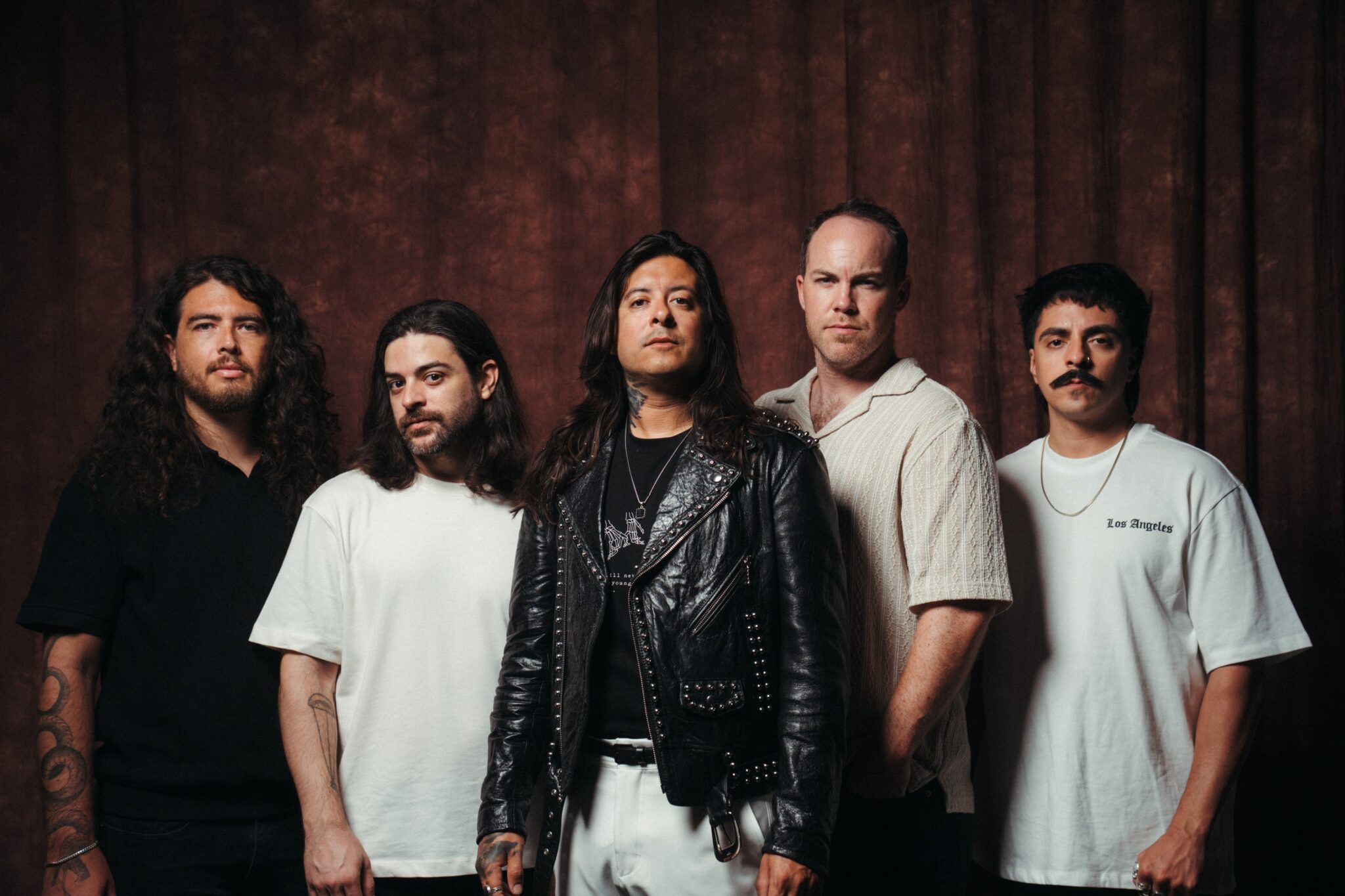


California-based rock outfit Hail The Sun ushered in a new chapter late October with the arrival of their seventh studio album, cut. turn. fade. back., a release that’s already been making an impression across packed North American rooms.
Shaped under the guidance of Pete Adams and GRAMMY® winner Johnny Kosich of Beach Noise (Kendrick Lamar), and sharpened by Zakk Cervini (Blink-182, Bring Me The Horizon, Coheed and Cambria), the record finds the band stretching their creative wings farther than ever. Its title’s four clipped words mirror the album’s circuitry – moving through conflict, collapse, return, and rebirth. Across 11 tracks, the band wrestle with military violence, humanitarian crises, addiction, grief, and love lost, all while mapping the loops those experiences carve into the human condition.
Long-time listeners know Hail The Sun always write with the lights turned inward. Their catalogue has never shied from the deeper corners of consciousness or the uneasy questions that shape existence. That’s been the case since the band—lead vocalist Donovan Melero, guitarists Shane Gann and Aric Garcia, bassist John Stirrat and drummer Allen Casillas—formed in Chico, CA in 2009, but especially the case on their latest full-length.
We sat down with frontman Donovan Melero to dive into the album’s inner workings and to hear more about the band’s long-awaited return to Australian stages.
HEAVY: First of all, congrats on the new album. For anyone wanting to know more about it, what does the title Cut. Turn. Fade. Back. actually mean?
Donovan: It’s a cyclical theme. First off, I like the aesthetic of it, and that’s a real big one. I love the idea of just a straightforward one-word period, one-word period title. We’re not trying to have a metaphorical type of title. There’s nothing wrong with that, but I just like how blunt it sounds and how dry it is. But it really is cyclical in nature. You might cut something out, and in doing that, you’re turning away slowly; it may or you may fade towards it again, and then you’re back.
H: You worked with Beach Noise. It’s a team rooted in hip-hop and experimental, which you’ve spoken about. They’ve worked with Kendrick Lamar, and you mentioned that you two grew up in the punk scene, and he even did merch for you at one point?
Donovan: Yeah, he did merch for us at one point, yeah.
H: That’s cool, a bit of a full circle moment in some ways. How did his experience in the hip-hop and experimental world influence the sound for this album?
Donovan: It’s hard to say because they both also wear such great rock hats. And Pete Adams was the other producer here and is a giant driving force for that as well. So it’s hard to say how that may have influenced them. I think that they’re both very potent songwriters, but also good at hearing sparkly production ideas with either sound effects or even just noise moments and transitional ideas. And with a band like us, we are also just so incredibly capable, where all of our minds together just flow towards a common goal of strong rock songs with weird but potent production and cohesiveness.
H: Thematically, the album cycles through addiction, war, lost love, and mortality. Did you go into the writing process with those topics sort of at the forefront of your mind? Did you know that this album was going to be about that ahead of time?
Donovan: Not at all. Once the music is starting to take shape, then the concepts and the lyrical ideas and the melodies start to flood my brain, or they won’t, and it’ll take a while to really figure out what something’s going to be about. Sometimes it’s instantaneous, and sometimes it takes more time, but it all comes after.
H: Do you connect the dots sometimes when you listen back to something?
Donovan: Sometimes, but I really try not to go into it ahead like that. I’m actually not the biggest fan of what one might call a concept album. I feel like concept albums have felt very constricting. It feels like an English writing project where you have to write within the bounds of something. And that might be fun or a nice exercise for some. But for me, I want to be able to just have free flow, and I don’t want to have to leave something out or try to stick to one agenda. That can actually be very difficult for me. It’s nice when they do all connect, and usually, there is some type of parallel there as it has presented itself in moments on the new album. But I definitely don’t try to do that as we go through it. Maybe halfway through, I can start to see a theme develop, and I’ll try to intertwine it, but I don’t set out with that in mind. At least I try not to. It just feels very inhibiting.
H: You’ve always been willing to question the nature of existence and identity. 15 years in, what are the questions that you find yourself returning to the most as an artist and as a human being? Is there anything that you’ve better understood through your art in terms of human existence?
Donovan: That’s a really great question. One question that keeps cycling through at least myself, as we’ve been a band, is the idea of “What is consciousness?” What does it mean to be aware? Why do I have thoughts that I have? What makes an inner being? What is our inner being? What’s it feel like to be in alignment?
And the more that I’ve learned and dove into these types of things, the more that I’ve realised is to feel good and to feel set on something and have it resonate with me, is when I’m the most aligned. And so I try to really pay attention to that. But a big theme with Hail has also been the idea of really trusting what we’re doing, even when sometimes it feels scary. Within reason, I try to live life as if I’m controlling myself in a video game. What would I do in a video game? Would I be afraid to take risks in a video game? Would I be afraid to do what I want to and be as safe as possible? And the answer is “Absolutely not, f**k no.” I want to be as outrageous as possible. I want to take these risks because we could die tomorrow. It sounds morbid, but it’s more inspiring because we have the time in this physical body that we have right now, so with that being said, we’ve really had to trust our process.
We’ve always learned to trust the direction of our band and to always make decisions based on the way that we feel. We’ve never let tangible or financial circumstances be the only thing that dictates our decision, and I do think that has to do with what I would say is our inner being’s calling, and just to listen to that. To not pinch myself off from the source that’s been channelled through my current physical being, as Donovan Melero to write the songs that we write. To really pay attention to that and not get distracted by outside factors that don’t serve what feels good. And that feeling good is the inner being and us being in alignment.
And tying it back into the album with Cut. Turn. Fade. Back. I mentioned we worked with Kris Crummett, who’s incredible. Nothing was broken. Nothing needed to be fixed. But it was the idea of even as we were writing these songs with these guys, I’m like, “I want to do more of this. I actually want this to be what we do. I want to go this direction.” And Kris has plaques upon plaques upon plaques; he’s so good. You can’t go wrong with Kris. But I wanted to trust that initial desire to want to just switch things up. And it’s nothing to do with him at all. We decided to trust our gut to just try something different.
H: One of the things that you’ve mentioned was that you were really proud of the fast turnaround of this record. From the time that you jammed it earlier in the year and then recorded it straight off the back of a tour, and then you went into filming six videos. That must be incredibly intense physically but also mentally, all things considered. How did you kind of take care of yourself during that period to come out the other end and be whole?
Donovan: That’s a great question. I don’t really know that I have an answer other than I just really love what we do. So even during all the tiredness and during the fatigue, it’s stuff that I’m grateful to do. In any of those moments, and I do this a lot, I think about when I was 12, 13, 14, and how this is all I wanted. I wanted to experience that. It felt like the right thing to feel when I was so young. So when it does get to that point, I understand the importance of taking care of our mentality and taking time off and making sure that we feel whole with the physical and mental strain with what we do.
That being said, I also can’t believe this is my reality. And so as much as I can shove into this life experience for this current moment, I want to do it. So in a strange and almost cliché way, doing all that stuff kind of helps take care of me personally through the process. As long as I can sleep. A more tangible answer is I make sure to get as much rest as I can, when I can. And I do my best to eat well and drink enough water because all those things will lead to making sure that I’m at my peak performance to do what I love to do. But this is really what I like to do. So it’s not too difficult.
H: You mentioned that you’re a booking agent for Sound Talent Group as well as a musician. So, as someone who lives on both sides of the fence in terms of the music industry, how has working on the creative and business side influenced your view of the modern music industry?
Donovan: That’s a great question. I feel like I have a very unique perspective and look through the window as an artist, and what it does for me as a booking agent is because I’ve travelled so many of the roads as the artists that I work with. The stuff that I’m doing, I’ve done. I know these clubs. I know these rooms. I know these buyers. I know a lot of them personally. So when it comes to something as basic as routing a tour, I know what’s gonna be difficult or what makes sense. But also being in all these different cities and being around the different environments and music scenes has allowed me to not just look at stuff on paper and what the stats might say. For instance, San Antonio is a city that one might not usually pick over Austin, Texas. However, I know that my roster and the bands that I’m working with in a certain genre are going to have a much bigger show in San Antonio because I’ve been there. I’ve done it. I’ve seen what that is like. I’ve seen that world. I’ve been able to see in person with some of the markets where if a talent buyer doesn’t have faith in the package, but I know it’s going to do well, I’ll get the best door deal that they’re like, “Sure, we’ll give you a door deal. That’s totally fine.” Thinking they’re getting the better end of it, but we end up making more for the artists that I’m working with than they would have by asking for just their normal guarantee, because we know what it’s going to do.
I also have a really great understanding of the value of relationships, and, really, for better or for worse, the politics that go into a lot of the different worlds and the different camps. I feel like I’m good with people skills, and I also really enjoy being around people and talking to people. I love connecting, so being able to navigate different types of personalities and different types of situations in both the artist side and the industry side has helped me on both sides.
H: Finally, you mentioned before you’re coming to Australia, touring five of our cities. What details can you give so far? When’s it happening?
Donovan: I don’t know the exact time, but I think it’s going to be sometime in our next summer. June, July. Yeah, that’s the plan.
Get cut. turn. fade. back. HERE