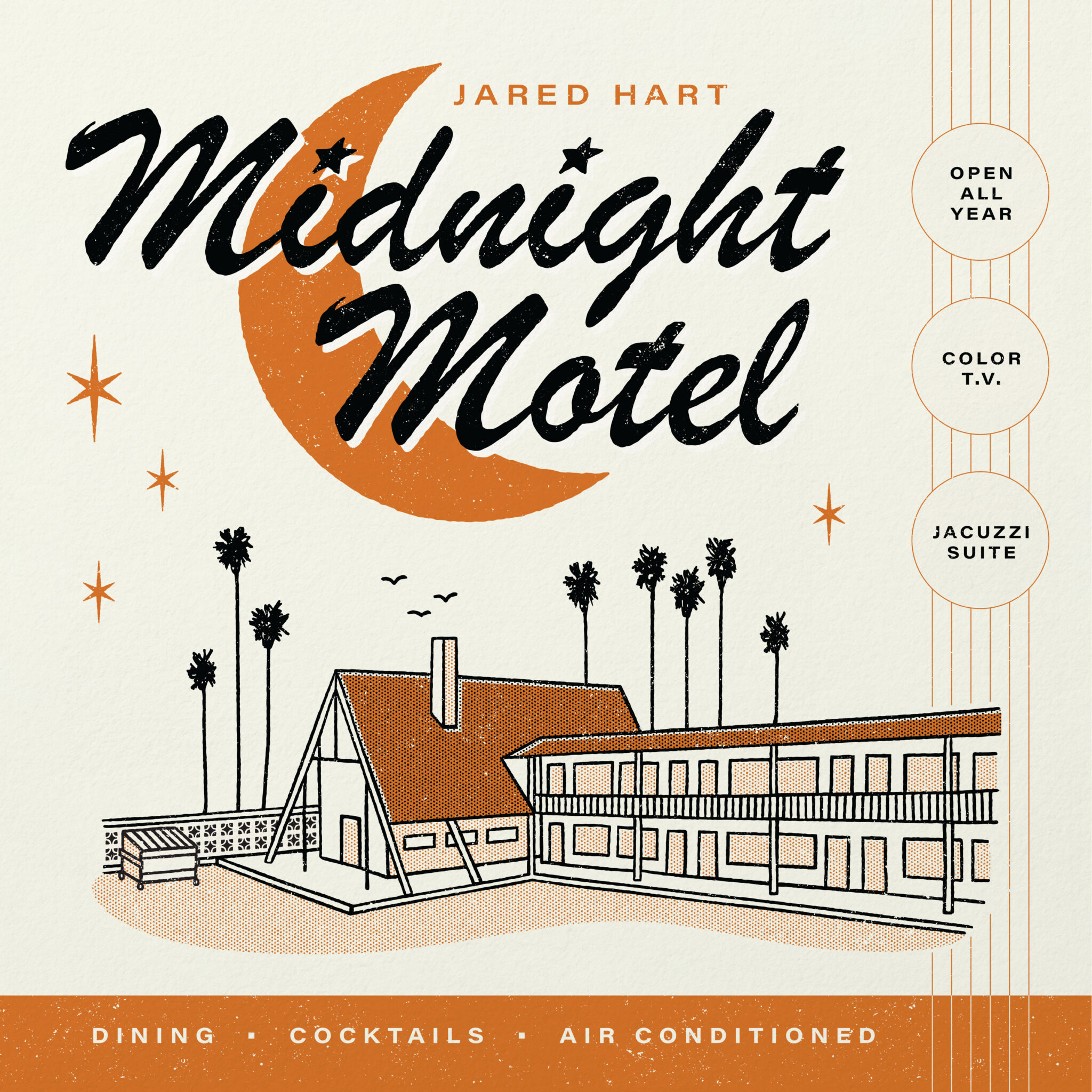



Out 28 August 2028
Via Mt. Crushmore Records
Words by Annette Geneva
I was more than curious when Jared Hart’s new album promo landed in my inbox. The imagery, the vibe of the record, the song names. I must admit that I had not heard much of Jared’s work before, but the line “for fans of Brian Fallon and Dave Hause…” sold me.
I wish record stores still had those little “for fans of…” tags. They were incredibly helpful. Give me three names I already love and suddenly I have a glimmer of the world I’m about to walk into.
And oh man… that was spot on.
I did a deep dive. The solo stuff. Mercy Union. The history. The songs. The New Jersey connection. And I’m genuinely grateful I did, because Midnight Motel is staying in my playlist.
What initially pulled me in was the imagery. I’m a sucker for Americana when it comes with a little rust around the edges. Give me a motel sign glowing somewhere off a highway, a bridge out of town, an old bar, a car driving through the night and somebody trying to figure out where the hell they belong, and I’m probably already halfway invested.
But then I heard the songs.
The album opens with Friends With Beneficiaries and it’s a hell of a way to introduce yourself.
There is humour in it, but underneath that humour is something much more worn and bruised. Hart writes about friendships, conflict, permanence dissolving and the uncomfortable realisation that sometimes the people you think you know best can become the people you have to navigate most carefully.
The line “When you can’t tell the difference between a friend and a landmine” stopped me. That is such a good image because it manages to be funny, threatening and sad at exactly the same time.
Then there is the very Jersey imagery:
“Like a Jersey beach. You just can’t compete.”
And suddenly I’m hearing the geography of this record. Not postcard New Jersey. Not Springsteen-as-tourist-brochure New Jersey. This is the New Jersey of bridges, beaches, basements, highways, old friendships, bruised knuckles and people who have known each other long enough to hurt each other properly.
Hart’s history with Mercy Union makes that world make even more sense. Going backwards through his catalogue, you can hear the connection between the larger, communal rock songs and the more intimate storytelling of his solo work. There is a lifetime of punk, heartland rock and American songwriting sitting underneath this record, but Midnight Motel feels particularly interested in what happens after the noise stops.
Bridges brings us back to New Jersey. Hart has spoken about growing up in a place where getting in or getting out often meant crossing a bridge, and it becomes one of those perfect images that works both literally and emotionally. A bridge is an exit. A bridge is a way home. You cross it because you’re leaving somewhere, but you might have to cross it again to get back.
That feels like the central tension of Midnight Motel. Leaving and returning. Holding on and subtracting. Wanting space and wanting somebody to come back.
Trying to work out what is actually worth carrying.
Room Keys is where Jared Hart really got me. I have a motel room keys tattoo. It says “Everyday Is Saturday.” So perhaps I was always going to be completely susceptible to this song.
I have a longstanding obsession with motel Americana. The architecture of temporary living. Neon signs. Little plastic keys. Anonymous rooms. Bad carpet. The hum of an air conditioner. A car sitting outside beneath a sodium streetlight. That strange romance of being somewhere nobody knows you.
A motel room is a place you are allowed to disappear. And Room Keys understands that. Hart sings about feeling like “a stranger In your own goddamn home”, and that landed somewhere very specific for me. I’m a mother. Sometimes motherhood can be so total that you become almost entirely defined by being needed. Your house is your home, your children are your world, your responsibilities follow you from room to room, and occasionally you need to step outside all of it just long enough to remember there is a person underneath the role. So sometimes I book a local hotel. A little staycation. One night. A bag packed. No laundry. No one asking me anything. Just a bed, a shower, music and a door that locks.
The song talks about needing space, learning to be free and eventually returning. The motel isn’t necessarily an escape from home. It becomes an escape that allows you to return to home as yourself. And suddenly my stupid little “Everyday Is Saturday” tattoo feels like it belongs directly inside this song. It’s a permission slip. A reminder that not every day has to be useful. Sometimes you can check into a room, shut the door, put on a record and let the rest of the world wait until morning.
That is my kind of Americana.
But what I love about Hart is that he doesn’t romanticise the escape completely.
These songs are full of people who want to leave and people who don’t want to be left. “Ready To Go” with Ben Nichols of Lucero and backing vocals by Casey Macalush sits right in that tension. The title sounds decisive. The emotional reality is much messier. “I’m not ready to go” keeps pulling against the idea of leaving, and that contradiction feels like one of the album’s central ideas.
How many times do we say we’re ready before we actually are?
Hart’s musical family appears all over the record too. Casey Macalush contributes vocals, Mercy Union’s Nick Jorgensen plays bass on several tracks, Matt Olsson handles drums, Mark Masefield adds keys and organ, as well as poet Mischa Pearlman who appears on “Ready To Go.”
Tilted takes the record out onto the road. This is probably the song that most obviously makes me picture the motel sign, the car and the highway.
“You gotta run it out of state. And ditch the Jersey plates.”
There it is. The great American escape fantasy condensed into two lines. Get out. Keep driving.
The song is full of cars, state lines, passenger seats and the promise of somewhere else. There is even the image of waking up in the passenger seat to the smell of the breeze, while Hart carries the memory of someone on the corner of Atlantic Avenue. That is such a cinematic piece of songwriting.
And suddenly the Don Henley comparison in the press material makes sense. Tilted carries that Boys of Summer kind of nostalgia, but it feels rougher around the edges. Less California dream, more Jersey plates disappearing down the highway.
Law of Subtraction pushes that idea even further. It’s about mistakes, miscalculations and being backed into a corner, with Hart’s solution essentially being to run straight through the wall and hope there’s something better on the other side. I appreciate that.
The Mantle is next and it’s central question is devastatingly simple:
“What am I to do. If I cannot hold onto you?”
And then Hart writes:
“And If I go first. Save a spot for me on the mantle Sell all my things Give them all away.”
There is something almost ghostly about it. The mantle becomes a place for memory. A physical place where somebody might remain after everything else has been stripped away. It’s the saddest song on the album.
Seafoam Green might be one of my favourites lyrically. It starts in childhood:
“Backyards are where this starts. Half an hour lovers driving stolen cars.”
Immediately we’re back in that American landscape of young people, cars, roads, bad decisions and enormous feelings.
Then Hart sings:
“You got a young man’s heart. So go and tear it apart.”
There is so much tenderness underneath the threat in that line. It’s about knowing somebody well enough to understand their capacity for destruction and loving them anyway. And the repeated image of seafoam green gives the song this strange, faded cinematic colour. The lyric “To me you’ll always be seafoam green” feels like the ultimate act of remembering someone.
Not remembering exactly what they looked like. Remembering the colour they became in your mind.
That’s what Hart seems particularly good at throughout this record: turning memories into physical objects. A key, a bridge, Jersey number plate.
Late Checkout follows the same trajectory. Laced with colour, metaphors and heartache in the way the song arrangement works against Hart’s voice.
The final song might be the one that makes the entire record click.
Hart began writing Downwhen years ago. He had the first verse and chorus sitting around for a long time before returning to it and finishing it from the perspective of the person he is now. That is almost the perfect metaphor for this album.
“Yeah we used to hang out. Now we’re barely hanging in.”
That’s the record. Friends grow apart. People die. Relationships change. You become a parent. You leave. You come back. You become someone your younger self wouldn’t recognise.
And then, somehow, you look backwards and realise that the person who wrote the first verse of the song isn’t the person who finished it.
Hart himself describes the song as revisiting where and who he was when he began writing it, then attaching the context of the life he’s living now. He calls it the “bow” that seals this point in time before the next adventure.
That’s exactly what a closer should do.
The more I listen, the more I understand Midnight Motel isn’t actually an album about motels. It’s an album about temporary places…physical places and places our mind takes us to. The friendships that become landmines. The bridges we cross because there is no other way out.
The rooms we rent because we need somewhere to breathe. The people we remember by colour.
The stories we finish years after we began them. And the things we finally decide we can leave behind.
There is something wonderfully unpolished about the emotional philosophy of this record.
The further I dug into Jared Hart’s catalogue, the more Midnight Motel made sense to me. Mercy Union gave me the context. The solo records gave me the history. The new songs gave me the present tense.
And now I’m sitting here with a record I wasn’t expecting to fall for. Which is probably the best way to find one. I came for the “Brian Fallon and Dave Hause” recommendation. I stayed for the motel keys. And I’m leaving the record on repeat. I’m so glad I got to hear it.