



Success carries its own kind of fear, a subtle unease that whispers it could all disappear in a heartbeat. On Relapse, Hayden McGoogan captures that fragile space with striking clarity.
Musically, the track resists drama. Despite McGoogan and his instrumentalists coming from different sonic backgrounds, the track deliberately holds back. The tempo is restrained, almost patient. Hayden and the band reportedly had to remind themselves to “let this one breathe,” and that decision truly defines the song. The rhythm section doesn’t rush toward a climax; it settles into presence. In that way, the pacing mirrors recovery itself; staying in the moment, not sprinting ahead.
Recorded live with the full band in one room, featuring acoustic and electric guitars, bass, drums, pedal steel, and piano, the track conveys the subtle push and pull of musicians reacting to one another in real time. There’s no over-polished stacking of takes, no sterile perfection. You can feel the eye contact in the rhythm, the air moving between instruments. It sounds lived-in, human.
A warm piano line threads through the track, while pedal steel adds texture rather than spectacle. Later, the violin swells gently in the background, lifting the emotional weight without overwhelming it. Even the strings feel intentional and not cinematic for the sake of drama, there to underline what’s already present in the lyrics.
And this is very much a lyric-forward song.
Unlike the wall-of-sound chaos of his more punk/rock past, everything in Relapse spotlights the vocals. The instruments frame rather than compete. McGoogan’s voice is raw, raspy, and textured. It sits front and centre. There are flashes that recall Kurt Cobain in the grain of his delivery, but here the grit feels controlled rather than explosive. Once pushed to sing as though his voice were “on the edge of dying,” McGoogan now uses that rasp as a choice, not a crutch, leaning into vulnerability over perfection.
When he sings, “I pray the last time is in the past,” it lands with plainspoken weight. Early versions of the song reportedly leaned more heavily on poetic language, but stripping it back has made the sentiment hit harder. There’s an emotional candour reminiscent of Jason Isbell (brutal honesty over metaphor) though musically McGoogan leans into a faster, country-tinged pulse rather than slow-burn Americana.
Vetty Vials’ harmonies add warmth, softening the edges without diluting the grit. It’s a subtle but vital presence, a reminder that recovery, like music, rarely happens alone.
What makes Relapse compelling isn’t just its subject matter. It’s the headspace. McGoogan describes it as “dark, but optimistic.” That duality runs through the entire arrangement, from the push and pull between steady drums and aching keys to the balance of restraint and release. It’s not a song about hitting rock bottom, but about getting back up while still fearing another fall.
Written around a month into sobriety, the song doesn’t dwell on falling back into addiction. Instead, it sits in the tension of hoping not to. As he puts it, it’s “not about relapsing- it’s about hoping I don’t.” That caution hums beneath every note.
For an artist who has spent years performing in high-energy punk and rock scenes, this shift toward space, breath, and lyric-focused storytelling doesn’t shout its message; rather, it holds it gently.
Hayden is definitely one to watch, an ideal fit for pub settings and venues like The Enmore, where he captivates the entire room. He has a way of pulling listeners into his journey, one that’s rarely shared so openly. It feels like the audience becomes part of the journey without even acknowledging it at first, being there for him in his mind through his toughest times, just as he is for us through his music. For a dose of raw, honest homegrown music paired perfectly with strong and poignant lyrics, don’t miss Hayden’s shows. Get ready to feel the strings of your heart tugged in time with the strumming of his guitar.
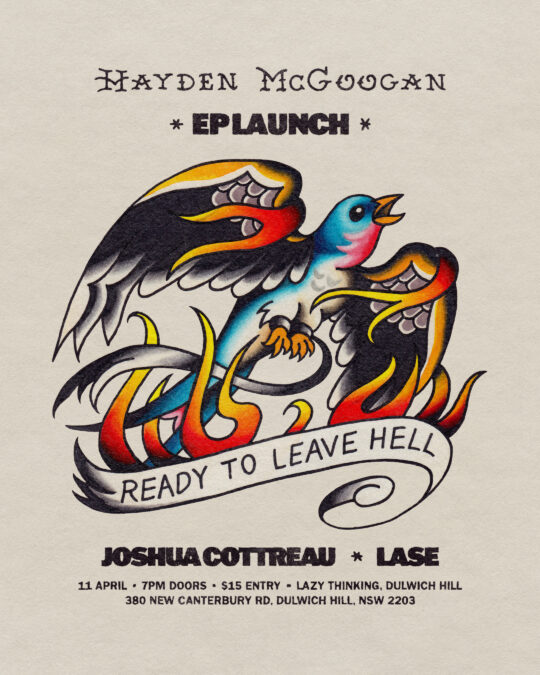
Catch Hayden‘s EP Launch at Lazy Thinking on April 11.