


Interview by Kris Peters
Iron Maiden tower above the majority of – not just heavy metal bands – but any band that has ever been or will be. They are a musical enigma that are still at the peak of the powers more than fifty years after bassist Steve Harris put the band together, having survived a myriad of hurdles and obstacles placed before them by the metal Gods and emerged triumphant at every turn.
Until now their musical journey has been documented solely via their music and countless live shows, with Iron Maiden etching their names into music history over 17 studio albums, 13 live albums and 47 singles which have sold in excess of 100 million copies worldwide. But there was always one thing which eluded them. A product of the modern age of music which has been embraced by a growing number of bands with varying success.
The documentary.
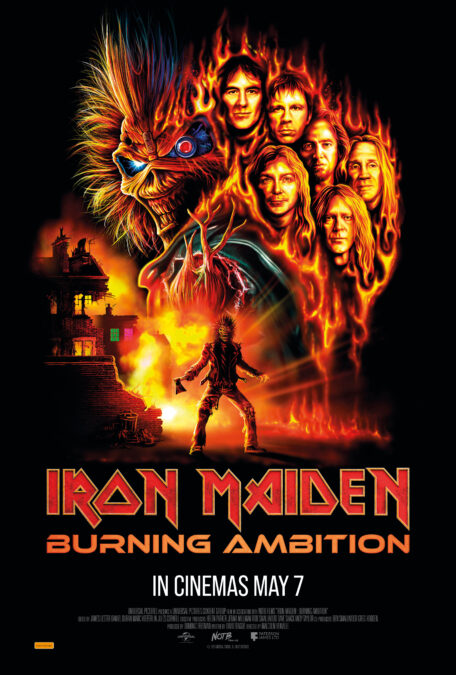
That all changes when, on May 7, Universal Pictures release IRON MAIDEN: BURNING AMBITION. With unprecedented access to official band archives, IRON MAIDEN: BURNING AMBITION charts five decades of one of the most iconic journeys in music history. Featuring interviews with the band and contributors such as Javier Bardem, Lars Ulrich, and Chuck D, this electrifying film offers an intimate look at their uncompromising vision and unwavering connection with their global army of fans, as well as all-new animated sequences of the band’s legendary mascot, Eddie.
The film offers a rare and intimate look at Iron Maiden’s uncompromising vision and unwavering connection with their truly global army of fans. It is a movie that refuses to sugar coat life inside of a successful heavy metal band, with moments of unflinching honesty that highlight pivitol moments of Iron Maiden’s rise through the ranks with little thought given to playing things safe or by the book.
When HEAVY gets the chance to speak with Iron Maiden frontman Bruce Dickinson, one of the first things we ask is whether or not these moments were confronting at all to watch or live back through.
“When we knew there was going to be a documentary the first thing was that we really didn’t want to be involved in it in terms of editorial or whatever,” Dickinson replied. “You have to have a hands off approach because you want somebody to look at it and tell the story. Obviously, there’s so many… this documentary could be ten hours long but then everybody would lose the will to live (laughs). So you’ve got to make the story concise. There are going to be fans who say ‘oh, they missed out this and what about that’ – yeah, sure – but for people who don’t know the story of Iron Maiden this is a great introduction to the band.
Bcause of that we wanted an external take on our career and you can’t really be fiddling about with that and going in every five minutes saying change this or I don’t like that. Oh, my hair looks messy in that picture. None of that crap. We’re not a bunch of poodles. It is a bit warts and all, but I think that’s great. There’s nothing in there that I would want to change.”
The film pays due respect to Iron Maiden‘s ever growing and passionately loyal fanbase, with fan based opinions and thoughts being given ample air time. While acknowledging the genuine bond between Iron Maiden and their fans, Dickinson also stresses that he feels closest with his music family while performing.
“There are lots and lots of ways to interact with the fan base,” he nodded. “There’s also different ways to be creative, given different kinds of media that are available, but the core of Iron Maiden has always been old school, on stage, in your face and that won’t ever change. If it’s going to be an Iron Maiden show, then it’s gonna be live. The fact we’re on a giant stage with a screen and everything else doesn’t make any difference to us. We just treat it like it’s a big club. I’m sure… Steve is on stage playing to 80,000 people and he might as well be playing the Cart & Horses in Stratford because he’s got the same attitude.”
As well as featuring fan fuelled narrative, Iron Maiden: Burning Ambition also welcomes fellow musicians and peers such as Scott Ian, Gene Simmons and Lars Ulrich who sporadically relay their feelings for Iron Maiden and some stories and moments they have shared over the years.
“It was great (having fellow heavy metal artists involved in the film),” Dickinson smiled. “For me the show stopper was Javier Bardem reading the lyrics of Run To The Hills as if it were a poem. You realize why that guy is such a great actor is because he can deliver the clauses and the lines with dramatic effect. But also it made me sit back and go ‘you know what, we’ve written some pretty cool words over the years'”.
The entire history of Iron Maiden is explored, including Dickinson‘s joining of the band and the reasons behind the split with orginal vocalist Paul Di’Anno. While Paul was exceptional in his own right, it was when Dickinson joined Iron Maiden that their trajectory rose rapidly.
“The first time I knew the band was going to be huge was when I was in a band called Samson and I saw Iron Maiden – believe it or not we were headlining and Maiden was special guests,” he laughed. “I heard a lot of things about Maiden and I went to watch them and I went ‘oh my God, this is incredible. Wow’. My next thought was ‘I need to sing for those guys’. What I wanted to do with my voice and what I heard them doing… if you could glue those things together we could do something even better, that was my vibe. Then, when I did join the band, Number Of The Beast happened and my first try out with the band was in Italy, so that was my first ever Iron Maiden show at Bologna in Italy and we had to wait three days to do it because we drove all the way from London. At the time we thought we would do the show in Italy because nobody would review it down there (laughs). If it really sucks it never happened (laughs).”
One of the many highlights of the film is Iron Maiden’s 1984 visit to Poland. Many people of the modern age would not be aware of the many hoops that had to be jumped through merely to be allowed to play in Poland in that period, but Iron Maiden defied the odds to ultimately play a large part in taking heavy metal to a new frontier at the time.
“It was a funny one,” Dickinson smiled as he cast his mind back over 40 years. “There were bands that did tour behind – what was then – the Iron Curtain, but they were few and far between. By and large they were all sponsored by the state. Everything was pretty controlled with a lot of that stuff. When we went there it was a little bit like there was some kind of weird revolution going on, and in fact there was. We didn’t realise it, but a few years later – not that many years after we left – the whole state apparatus came tumbling down and they got democracy and Poland is now a free democratic country which is great. But at the time there was a desire for something which took them away from this heavy handed misery that was the former Soviet Union just squishing everything and trying to suck the life out of people. But the Poles are not like that. They’ve suffered for centuries being used as a kicking ball between different imperial interests, and yet they have managed to maintain their cohesion as a country and are now thriving. If we played a small part in that I think it’s brilliant.”
The film also documents the events after one of the shows on that tour where Iron Maiden found themselves invited to a wedding where they got up on stage and played a cover of Deep Purple‘s Smoke On The Water.
“There were a few surreal things on that tour,” Dickinson smiled. “The wedding was quite surreal, but what was also surreal was waking up in a Warsaw apartment complex in the middle of nowhere with a journalist – a guy called Howard Johnson – and we were both sitting there and we had been listening… – he went off with a girl somewhere. I tried but it didn’t work (laughs) – and we were listening to these cassette tapes which were pirate bootleg cassettes. They could all end up in jail if they were found with these tapes and they would pass them from one apartment to another and make bootlegs. That’s how they distributed music. That’s how they became aware of where things were at in terms of music. It was amazing. It was proper underground stuff and very exciting.”
One of the main thing that resonates from Iron Maiden: Burning Ambition long after the final credits roll is the strength in character of every person who has passed through Iron Maiden from management to stage hands to band members. Although making it clear that waters have been turbulent on many occassions, the film also reinforces the lifelong bond felt by Iron Maiden, with Dickinson closing by reiterating the enormity of Iron Maiden’s journey.
“I just wanted to be in the best rock and roll band in the world and for me Iron Maiden was going to be that band,” he affirmed. “Writing the songs and just trying to push the limits personally and instrumentally with the rest of the guys and see how far we could go. That was it. You’re 24, 25 years old, full of testosterone and it shows. Hopefully there’s still a bit of that kicking around (laughs).”