

Napalm Records
28 March 2025
Words by Jack Harlen
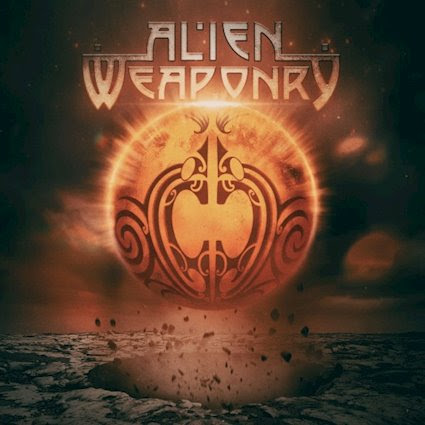
Today I get the privilege to review one of the most energetic metal acts of the past few years. New Zealand’s groove metal trio Alien Weaponry is set to release their third full-length album Te Rā, which aims to expand their brand of groove metal, weaving crushing riffs with lyrics in English and te reo Māori to create a sound that is both culturally profound and heavy as hell.
Te Rā sees the band in the hands of legendary producer Josh Wilbur (Lamb of God, Gojira, The Dillinger Escape Plan) who helps to push the album and band to their absolute limit, culminating in the heaviest offering the boys have released yet.
Full disclosure, I love this band and am prepared for a fun time and from the very first seconds of the opening track, Crown, I knew this album was not here to fuck around. It makes a statement early with a blistering riff, proving once again that Alien Weaponry is full of life and energy. Lewis De Jong delivers his vocals this time around with a new level of aggression only matched by his ferocious guitar playing and as the song opens up we hear just how this rage can transform into choruses that are anthemic with lyrical themes that talk about struggle and the unbearing weight of it all. Before that gets all too much, however, we get a fun, punchy breakdown complete with gang vocals in te reo Māori. With just the opening track, Alien Weaponry set the bar high, seemingly perfecting the sound they’ve been developing for the past two albums. Let’s see if they can continue this with their first single off the album Mau Moko…
Mau Moko starts out silently, with only a single guitar playing in the distance, while throat singing can be heard building in the background. Building towards… the most insane guitar tone this album has offered yet, playing a riff that is scientifically proven to get people jumping and throwing down in the pit. While drummer Henry De Jong does get to show off just how groovy his drumming can be, the lyricism here takes the stage as the most heavy element of this song. Mau Moko is sung completely in te reo Māori and talks about traditional face tattooing and the social costs of maintaining cultural customs in spite of cultural norms. The whole track reflects this in what feels like a call to war and while the chorus is melodic and catchy, the intensity of the track cannot be understated. If the breakdown of the track before was ‘fun’ then the breakdown here can only be described as violent; all elements of the band come together to sonically beat the crap out of you in a track that will surely become a live staple.
It’s still early on in the album, yet you can feel just how much life producer Josh Wilbur brings to Alien Weaponry with an improved sound and structuring that brings the band to its most creative. By the time we hit the next track and new single 1000 Friends, I’m completely bought in with a track that is so classic metal-core sounding I thought I somehow missed a Trivium feature. This strikes a perfect balance between being catchy without being annoyingly repetitive, heavy while also being a melodic anthem. The track has this natural ebb and flow to it that is accompanied by commentary on social media and its effects on people and culture. Alien Weaponry wears its influences on its sleeve and with this classic sounding track they show they can build on a sound that inspired them. For many others a song like this wouldn’t have worked and perhaps might have fallen into sounding generic, but this band proves otherwise by adapting that sound and blending it with their own unique style, creating one of the grooviest tracks on the album.
Hanging by a Thread matches that intensity with a main riff that slithers throughout the track contrasting the track before the song feels very modern with a sound that might conjure up some ideas of ‘Djent’. Tūranga Edmonds on bass is a highlight here as his playing punches through the song, providing an added thickness to an already beefy track. Following this we get the most pissed off Alien Weaponry has ever sounded on Tama-nui-te-rā. Naming a song and album after the Māori sun god should let you know this song was always going to be formidable. This track feels like a continuation of Mau Moko, the war chants, the frustrated vocal performance and instrumentation coming together in a rush of pure blood-pumping adrenaline. This type of sound was present on their last two offerings but here it’s pushed to its peak, exploding in a ball of pure energy. It’s incredibly impressive how well put together these tracks are.
Slowing back down as we pass halfway, Myself To Blame comes in with a melancholic performance. Clean guitars start us off as an emotional Lewis De Jong delivers some impressive vocals that sound emotional and personal to create a song I wasn’t initially sure the boys could pull off in an album so full of fire. Thankfully they prove me wrong with a strong chorus that carries us to a bridge straight out of ‘05 Gojira. It’s certainly the cleanest song in the album, but that doesn’t make it any less punishing.
Let me be blunt. This is the song you need to listen to. Anyone will tell you I’ll always insist you listen to the full album in order, start to finish…but if you can’t please listen to Taniwha. In what feels like a generational passing of the torch, this track features guest vocals by groove metal giant Randy-fucking-Blythe. Even more exciting is that this track doesn’t feel like they tried to create a Lamb of God track. This song is all Alien Weaponry DNA with lyrics in te reo Māori and English including a catchy chorus that has Randy coming in with some spoken word parts before we push the track into almost death metal territory with some beautifully heavy vocals from both frontmen. Hearing the pair trading off is the most sonically intense performance I’ve heard from the Kiwis so far. This song is dangerous.
A siren sounds as Blackened Sky thrashes away but following the track before it’s hard to not see this track as just fine. Truth be told I struggled to get super into this one. I’m almost certain however that this is my own fault and the song does get more interesting as it continues. I have no doubt the ‘fuck you’ ending will be fun live and at 3:06 I don’t dwell on it too much. The song’s pulsing drums and rhythmic intensity did keep me banging my head well into Te Riri o Tāwhirimātea where the more interesting structures and vocals get to flex on.
This is easily the most atmospheric track on the album. The main riff morphs itself into a jungle landscape as thunder crashes and rain pours down before the only guitar solo on the album slowly leads us back into tribal territory as te reo Māori is barked at us and the song returns to its heavy roots. This band recognises their strengths, and I do appreciate that not every song follows this formula. It’s what makes these songs around Māori concepts so much more rich and interesting. You can feel the thought and care that goes through creating a song around their cultural identities.
Rounding the album out, we reach Ponaturi. Blending technical guitar playing, nu-metal style vocals and the inclusion of unique instrumentation, this track serves as a mission statement for the album and the band as a whole. Here, nearing the end, Alien Weaponry prove they can double down on their aggression, creating space for these choruses to act as anthems and pockets of air before being dragged back under into what is possibly the most destructive the band has ever sounded. The cultural interplay of the band is no gimmick and is instead the heart and soul of the band as the track crescendos into a cacophony of Māori voices. You can imagine the seas of crowds chanting back at them, the modern-day messages of anxiety, fear and destruction spliced with Māori mysticism and practices showing the band has something grander to say and with this album have the sonic capability to beat it into you.
Closing us out is Te Kore, a short and sweet ending that feels as important as the first track, with big chords and even bigger vocals chanting us out. With the album coming to its end I can’t help but dwell on the story of Alien Weaponry. It’s one of constant evolution and Te Rā is another step forward, but this time around their third full length feels like it’s their most important. It’s a story that wants to be told, interweaving lessons from the past to express how utterly hopeless and pissed off they are in the present. This album is another incredible offering from the Kiwi trio, and I get the feeling they are just getting started.