
“Og dei spora eg trår, Er kalde så kalde.” – Einar Selvik, Wardruna, Helvegen & Helvegen II (2013 & 2026)
These illustrious poetic words have been charismatically chanted by Einar Selvik, vocalist, multi-instrumentalist and songwriter for Norwegian Nordic Folk outfit Wardruna, more times than he can recollect, and over many years in many different locations throughout Planet Earth.
Broady translated, the English representation of the wondrous lyrics above are as follows: “And the tracks I tread, are cold, so cold.”
There are many possible connections for Einar with this musical literature. Comprehensibly, the artistic impulse may have arisen from Mr. Selvik’s many global travels, whether as the voice enchantingly guiding Wardruna, or on his own solo tour as a musician, or as an educator in runic poetry, Nordic music history, and traditional instrument crafting. It may have even been inspired by his acting pursuits on the renowned Vikings TV series, or voice acting on the video game Assassin’s Creed Valhalla, where he was also a vital musician and creator for both of these scintillating soundtracks.
Perhaps, it is driven by his upbringing in Norway, exploring the beautiful forest lands in temperatures as low as -16˚ Celsius. Alternatively, this poetic passage, and charismatic composition, is potentially guided by the renowned tale in Norse Mythology of Odin’s sacrifice at Mimir’s well. In this narrative, the Ruler of Asgard sacrificed an eye in exchange for knowledge of the runes. The Allfather was also required to hang from a tree, with a spear stabbed into his torso, for nine gruelling nights. The runes represent language, but also magic and music; matter-of-factly this ancient Germanic alphabet and their true meanings, still remain to be a mystery for the most part.
In essence though, Helvegen can be recognised as a funeral song. “I daudsvevna slynge meg / Når eg på helvegen går” is interpreted in close proximity to: “Into deathsleep sling me / When I walk on the Path of Death.”
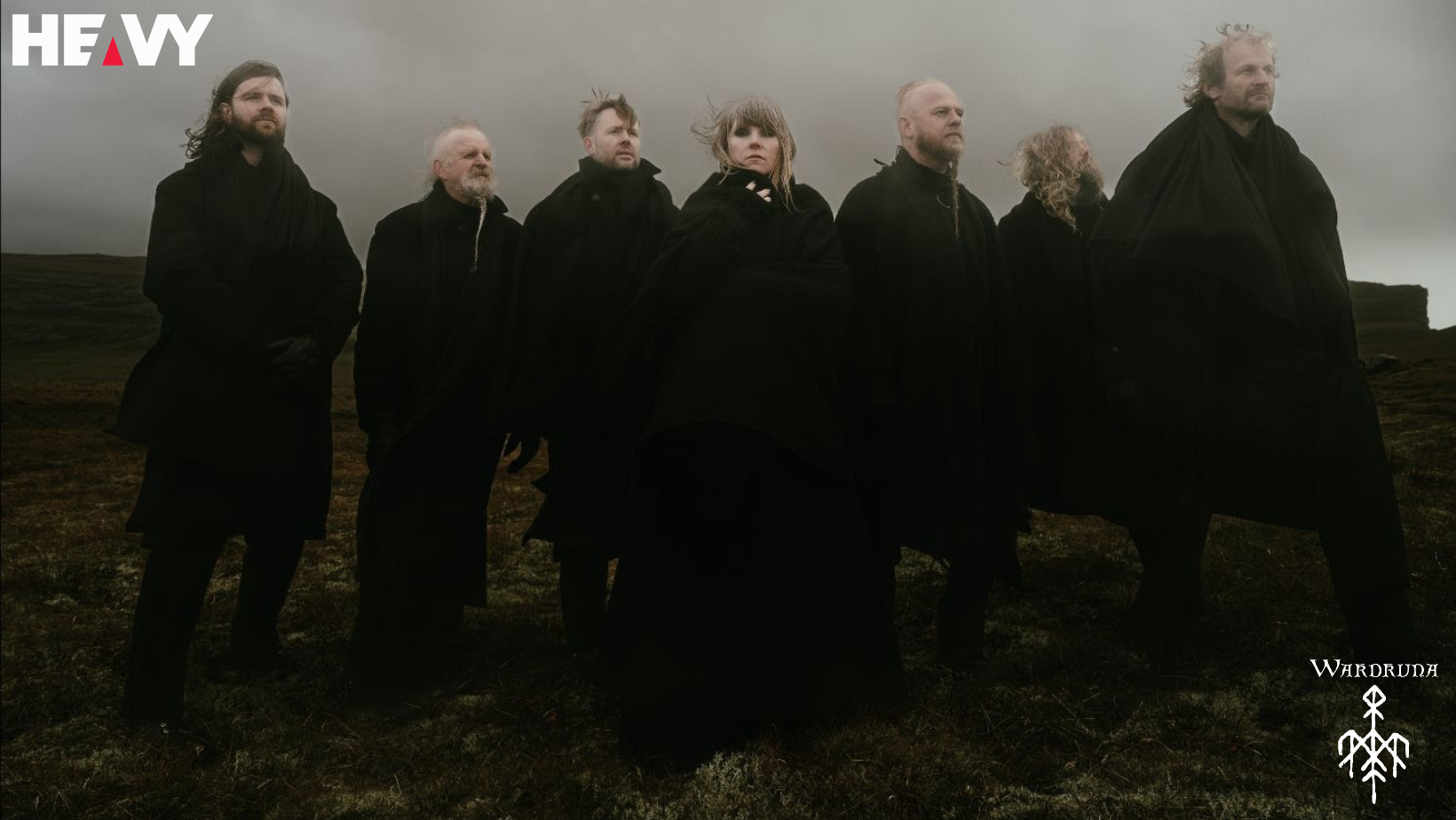
Conceivably, it is more than likely that all of these elements and more enliven Wardruna’s Helvegen. The tantalising track was originally unveiled upon the world in 2013, on the Nordic Folk collective’s second studio album entitled Runaljod – Yggdrasil. Since its release, the luscious lullaby has been a charming cornerstone of the Wardruna, and Einar Selvik’s live ritual. Over the many years of performance, the song has undertaken new dazzling dimensions in its sonic landscape, and for Einar, as well as the magical musicians and artists who embody Wardruna, which includes: Lindy-Fay Hella (vocals, flute), Arne Sandvoll (vocals, percussion), HC Dalgaard (vocals, percussion), Eilif Gundersen (horns, flutes) and John Stenersen (moraharpa), a resolution was reached to embark upon a creative journey that was “to encourage a renewed relationship with song, not only as something we perform or listen to, but as something that can accompany us through life,” as per Mr. Selvik.
When HEAVY makes contact with Einar from his home in Norway, he is inspirited with tranquillity. Since October 2024, Wardruna have essentially been touring non-stop, mostly in support of their spectacular sixth studio album Birna (the LP was released in January 2025, but the collective was already voyaging throughout South America and Europe prior to its global introduction). However, now that worldwide expedition has finally come to a close. Einar is beyond euphoric at home, surrounded by his historic musical instruments and artefacts, as well as being endlessly enveloped by love from his wife and children. In reflection though, the musician, educator, actor, storyteller and historian upholds a deep sense of elation from the past two years, as he describes:
“Well, it’s been very intense. [But] it’s been profound in a way. You know, we get to experience a lot of things. We get to meet a lot of people in beautiful places, but it’s very intense.” He pauses for a moment, as if trying to piece together his life from the last 24 months, and becoming disorientated, but delighted all at once in doing so. Then continues – “So, I can feel… [Honestly], we just like wrapped up. We did the final [ceremony], because we had to move a few shows that were supposed to happen in November and December last year; those final shows, we just did few weeks ago. So, basically now the whole Birna album cycle is over, and I have to say it’s a very good feeling to be able to take time to reflect, and to let it all sink in. To let life be life, and take a break from that. I think that’s very healthy; I look forward to having a break from touring and all of that.”
Were there any particular highlights?
“It’s always special to come to a new place with your music. So, of course, the tours we did in Australia and New Zealand, that was something I definitely carry with me as one of the highlights.” He declares with an impassioned tone. “I don’t know, performing in Pompeii, you know, in the ancient ruins of Pompeii, where the famous Pink Floyd recording was done. That of course, is pretty insane (laughs). We also performed on the Native American Blackfeet Reservation on sacred grounds for the Fire In The Mountains festival – we were sort of a big part of that whole project. That is of course also something I will carry with me. It left me changed a little bit, in a positive sense. I don’t know. The list goes on… There are so many things. I’m left feeling very humble and grateful to be to be part of part of whatever this is.”
“Whatever this is…” is an idyllic description of the humility Einar Selvik magnificently maintains. Warduna’s achievements are undeniably, above vast and monumental. The group received their first nomination for Norway’s premier music award at the Spellemannprisen (the “Norwegian Grammy”) in the International Success of the Year category in 2026. Their 2016 Runaljod – Ragnarok LP debuted at the top position of the North American Billboard World Albums chart, and maintained that position for numerous sequential weeks. The 2021 full-length Kvitravn attained the number one spot in Austria and Canada, second in Germany, and tenth in the Official Scottish Albums Chart and UK Official Albums Chart.
The Nordic Folk outfit has eclipsed 500 million incremental streams on Spotify, as well as 800,000 YouTube subscribers. They have sold out major international venues, including Red Rocks Amphitheatre, and headlined major European festivals. Wardruna are in fact, the only musical collective ever permitted to perform an amplified concert at the Viking Ship Museum in Oslo, playing directly in front of the 1,100-year-old Gokstad ship.
This prestigious list expands further, and with an esteemed level of virtue that is truly bewildering. However, their entrancing artistry is unquestionably, and endlessly their enlivenment. The recent release of Helvegen II, a remarkable re-embodiment of the 2013 track Helvegen, with the unequivocally divine short-film in accompaniment, is the amazing affirmation of this creative brilliance. It therefore plagued this writer to ask, over the many years of performing Helvegen, in an astonishing array of atmospheres (the exhibition of the single with avant-garde pop songstress Aurora is honestly, spellbinding Wardruna and Aurora – Helvegen (Live)), was there a point in time where Einar Selvik discovered that the composition called for a reconceptualization?
“Well, I did feel like the old, especially studio version, felt like… it captures THAT time. It captures the moment of creation. It captures, you know, all the friction that created the song, and all the questions, and all of that, which of course is what made the song into what it is. But I have increasingly felt that the gap between that version, and even the one we’re playing on stage today is pretty big. So, for quite a while, I’ve been feeling that I want to, at some point… I don’t know, bring it up to speed in a way. And I’ve also felt like this is a song that deserves a film.”
He elaborates further – “I didn’t want to make a video to this old recording. I don’t really feel it reflects what the song has become today, what it is today, even when we perform it. That recording is not going anywhere. That’s always going to be there. It’s more like it felt like the time to revisit it with care and respect, and all of that.”
Was it difficult revisiting a compelling single from many years ago, that has undergone an evolution in live demonstrations, and try to capture its elevation?
“It’s of course really challenging to go back and work on a song; it’s, difficult to have like the bird perspective on it. But yeah, it’s something we yeah been working on, probably on-and-off for four years now. It just felt like the right thing to do. I also had the idea of doing a like a new verse to the song that also reflects what the song has become, because it sort of has lived its own life. It has become so much bigger than us in a sense.”
How so?
“It comes from the song. It is created out of a desire for people to sing more, for people to sing more in connection to death and the dead ones. That sort of rekindling that old tradition, which is lost in most parts of the world today, and the fact that people use it for that, you know? People sing it, they play it. It exists in so many different languages. They use it to mourn their dead, but also when they give birth to their children, or get married. It’s a song that has become part of people’s lives. In a way, I wanted that last part to sort of reflect that. So, everyone who has ever used the song is now part of the new version – I kind of like that thought.”
Has the poetry of the composition undertaken a new meaning for yourself?
“This song is also part of my life, of my history, of my sorrows, and of my loved ones. So, it has a a story in my life, and whenever there is a new layer on that which involves that song, it of course changes my perspective. In the making of this film, it’s built on some very specific ideas, symbolic ideas, and of course in collaboration with Tuukka Koski, the Finnish director, who I’ve been working a lot with on our videos over the years.”
Helvegen II was released with a transfixing and mystifying movie that is pivotal to experience. Shot in the Westfjords region of Iceland, the heart-rendering and soulful cinematic innovation incredibly illustrates the majority of the discussed motifs to the track, but with embellished horizons open for interpretation.
“I can’t even tell you how many hours I’ve, or how much I’ve been thinking about this and discussing it and planning it, with all of these details. At the same time, you know, keeping it really ‘clean’. [Elements like] just having the long straight shoreline to walk on, you know? That border between two worlds, two separate worlds where they meet. I think that in itself is such a powerful symbol. But of course, having the raven as sort of the silent witness, but also the raven as the creature that moves between worlds, and carries the dead even. In a way, the raven is sort of the mediator between the worlds, witnessing, following, making it possible, making that connection possible.”
The performance by the actor and choreographer Sofia Ruija was irrefutably electrifying. Were you aware of her before the project came to fruition?
“Well, that’s something me and Tuukka (director) discussed for a long time. She was on our radar, because she has… you know, as a dancer, she has this – I don’t know, she just has this aura within her. So, in the end, you know, there are so many ways we could go, in terms of that role. But, it came down to like our gut feeling and heart, and we both felt that we needed to go for her and I’m so happy about that. She added something; she added things you cannot plan for, you can’t ‘book it’. She came with her ‘being’ in a way – there is no acting in that video. We didn’t have to, nobody had to act, everybody felt IT so strongly in that fucking harsh weather, and that crazy place in the middle of nowhere, where everyone said you can’t film up there. [We were told] ‘You can’t go with a big production and do a film up there, it’s too difficult.’ Everyone advised against it. But it had to be there, and it took a lot of effort and heart and work going into this, and I think that’s also what shows through the lens in a way as well. That’s what I feel when I see it, it feels just as real as it as it felt when we were doing it.”
“…everybody felt IT …” These three words immaculately encompass Wardruna’s moving spirit. Their soulful artistry and timeless graceful musicianship are not just heard and encountered; in entirety, IT IS FELT to intensities beyond description. The Nordic folk collective lived and felt their phenomenal lyrical message of: “Og dei spora eg trår, Er kalde så kalde.” (“And the tracks I tread, are cold, so cold.”) in Iceland for Helvegen II, but there are assuredly many more tracks to tread. Although, for now, Einar Selvik has his own path to take into the immediate future.
“Well, I’m definitely not gonna go back into the studio and start recording a new album, or plan a new tour. It’s now time to just catch my breath, live my life, spend time with family and nature. Of course, I love my job. I’m involved in in projects, and there will be more. I almost haven’t been able to do the lectures and solo concerts – stuff like that since pre-COVID, because there hasn’t really been time and space for it. So yeah, doing things that I have not been able to have the time to do, and have have a bit of a slower tempo for a while.”
“Då den djupaste brunni, Gav meg dråpar så ramme”